Five Classical Music Myths
By Thomas Wolf

Classical music has its own mythology. Compare the conductor’s baton to the Greek God Zeus’ thunder bolt. Both represent power and authority. (Photo source: Google images.)
ONE OF THE WONDERFUL THINGS about classical music is that those of us who love it live in a glorified world of mythology. Like the Greeks, we worship our gods, ascribing to them magical powers with tools that are all-powerful—compare the conductor’s baton to Zeus’ thunder bolt (both represent power and authority). Sometimes I wonder if these myths are intended to engender more interest, excitement, and love. If so, I should be loath to pierce the veil—especially since, despite much evidence, I believe in many of them.
Yet my hope is that by revealing some simple truths in this and other blogs, people will enjoy the experience of the art form even more and focus on what truly matters—the miracle of the music and the extraordinary talent of those who create and perform it. So here are today’s five myths.
MYTH #1 — Many of the most famous performers and orchestras of the past were superior to the superstars of today.
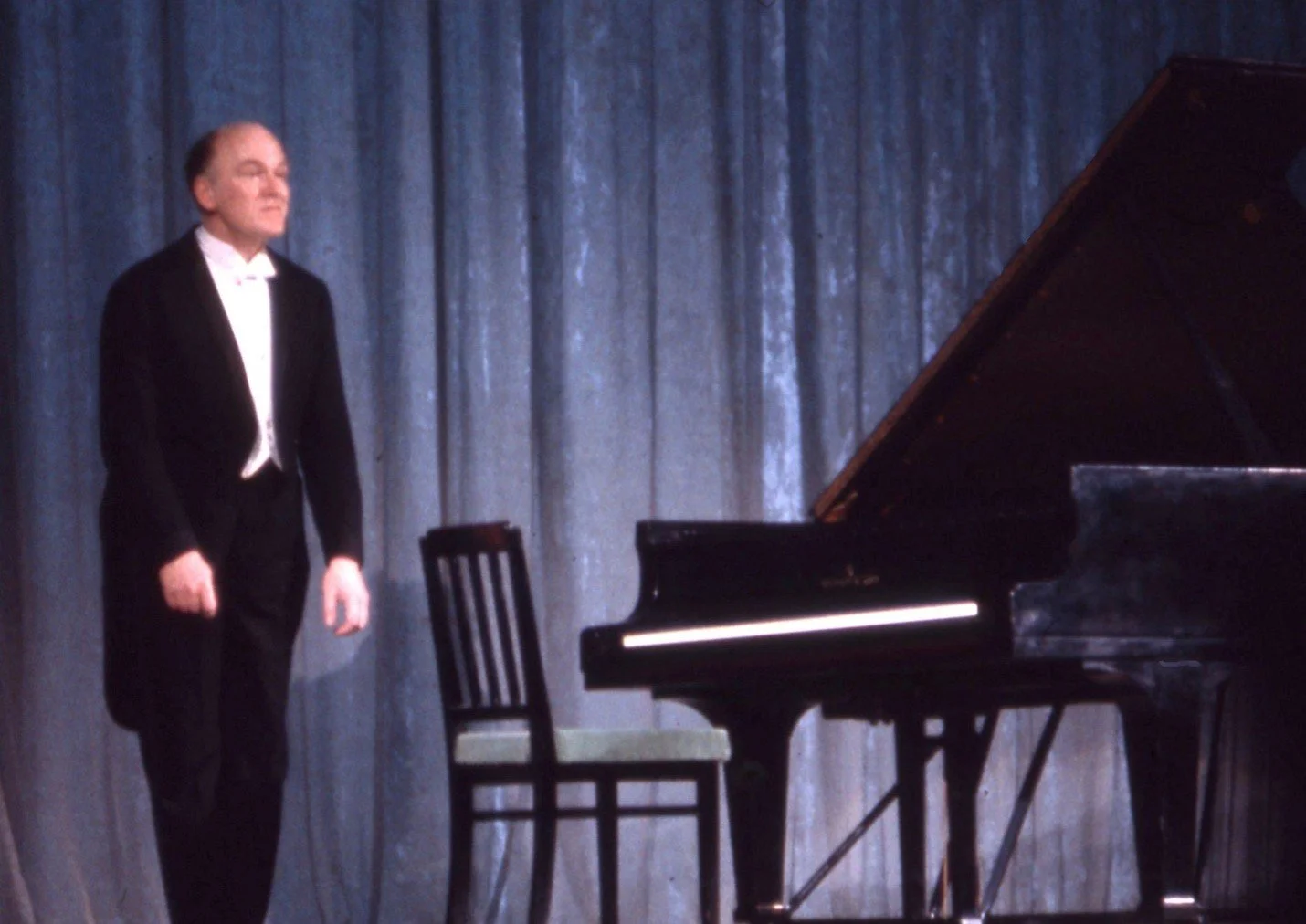
Sviatoslav Richter at about the time in 1960 when I heard him play an incomparable performance of the second Brahms piano concerto with the Philadelphia Orchestra. I have never heard anything since to equal it. (Photo source: University of Virginia Center for Russian, East European, and Eurasian Studies, Thomas Taylor Hammond (1920-1993), Creative Commons Attribution-Share Alike 4.0 International, Wikimedia. No alterations were made.)
I am eighty years old. When I hear people my age who love classical music talk about the great performers and performances they experienced in their early years, their nostalgia is often tinged with regret. Why can’t today’s performers play like the old timers? Nothing today, they claim, can compare with the great playing of former times. Sometimes, I find myself guilty of the same tendency. Ask me about the second piano concerto of Johannes Brahms and I will tell you unequivocally that the greatest performance of the piece I ever heard was when the pianist, Sviatoslav Richter, played it with the Philadelphia Orchestra in the Academy of Music in 1960. Nothing since has come close to matching it. To me, Richter’s playing was that of a mythological god. Yet a year later, when he performed in London, critic Neville Cardus asserted that Richter’s playing was “provincial” and he wondered why the pianist had been invited to play in London where there were already plenty of “second class” pianists.
The kind of selective memory that music lovers ascribe to performances and performers they have heard decades earlier can become an irritating habit. Even worse is when someone claims that famous musicians of the past, musicians that no living person has actually ever seen or heard in a live performance, were somehow better than those playing today. Sometimes we can hear versions of the performances of these big names on scratchy old recordings where the sound is distorted and the interpretation quite different from what would be considered acceptable today. We can like it or not (and often I tend to be a fan), but the major point is that in those instances, we are often comparing apples to oranges.
Interpretive styles in former times were very different from those of today. One may like exaggerated rubatos (expressive quickening or slackening of a phrase), more extreme changes in tempo, bass lines that don’t exactly align with treble, the languor of singing melodies (as I do), but I would have to admit that from a purely technical point of view, top musicians today, as a general rule, make fewer mistakes, play fewer wrong notes, and have intonation that is more accurate—not that I care about these things when I feel the overall performance is profound.
But many music lovers do care. When people wonder what it would be like to hear very early performances of classics—say a Mozart opera conducted by Mozart himself—it is quite possible they would likely find it perplexing at best and disappointing at worst. Performance practice evolves. Greatness is in the ears (and selective memories) of the beholder.
I will never forget a comment by the former concertmaster of the Boston Symphony, Joseph Silverstein, who I encountered attending a concert of his old orchestra at the Tanglewood Music Center one summer well after he retired. I asked him what he was doing there. “Oh, I try to take in as many of these concerts as I can. It is so great to hear these guys. They play so much better than we ever did.”
MYTH #2 — Modern string instruments can never match the unbelievable quality of those created several centuries ago.
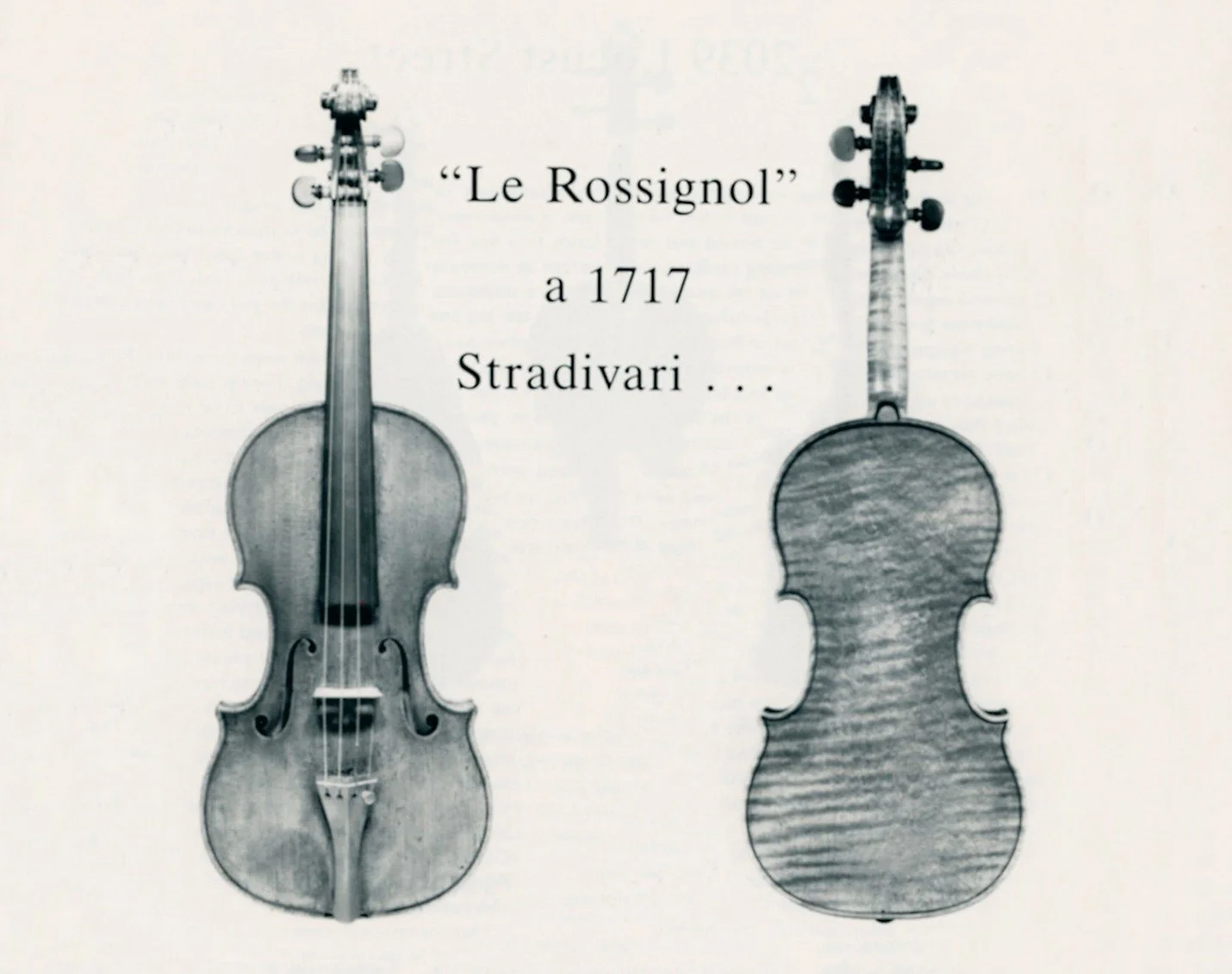
My grandmother’s golden period Stradivarius violin, Le Rossignol (or The Nightingale). Was it really better than every modern violin? (Photo source: Luboshutz-Goldovsky-Wolf Family archive.)
An analogous assertion of old versus new has to do with string instruments like violins, violas and cellos. Many people believe the famous old instruments were and continue to be better than newer ones. There is no question that some of these centuries-old instruments that today fetch prices in the millions of dollars are unique and special. My grandmother played a so-called “golden period” violin (“the Nightingale”) made by Antonio Stradivari. Prior to that, she played a violin by the great Italian luthier[i], Nicolo Amati, while her sister, Anna, played a cello made by yet another legendary Italian, Giovanni Battista Guadagnini. These gentlemen made terrific instruments. But were these instruments better than the best violins, violas, and cellos constructed in recent times?
If the criterion of “better” is that the sound of the old instruments is superior, more pure, more beautiful, or can project better, or that musicians find them more congenial to play, can this be proven in any objective way?
Happily, we do have some objective tests. People have set out to prove the seemingly incontrovertible fact of the superiority of the older instruments. But the results have consistently been surprising. Over and over again, in blind tests—even when the listeners and players were professionals—modern instruments have often won out over older ones, even the priceless instruments made by the legendary luthiers. Here is an example:
In 2012, a team led by French acoustics researcher Claudia Fritz and American violin maker Joseph Curtin invited ten professional soloists to Paris to blind-test six new and six old violins, including five by Stradivari. Each instrument went through three 75-minute evaluation rounds—one held in a rehearsal room, another in a concert hall, and the third in the same hall with orchestral accompaniment and a small audience.
The violinists were asked to choose a violin to replace their own for a hypothetical concert tour. “Six of the ten soloists chose a new instrument,” Fritz and Curtin wrote in the study, which was published two years later in the Proceedings of the National Academy of Sciences. “A single new violin was easily the most preferred of the twelve.” Quite decisively, the study disproved the claim that old Italian violins have unique playing qualities.[ii]
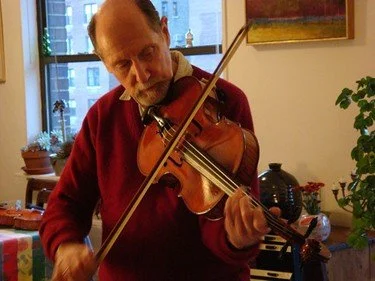
Violist Michael Tree owned a valuable 18th century Italian viola, but for much of his career, he preferred playing on modern instruments by the Japanese-American luthier, Hiroshi Iizuka, and the American luthier Harvey Fairbanks of Binghamton, New York. (Photo source: Wikimedia Commons.)
I will never forget a conversation I had with Michael Tree, the late great violist of the Guarneri Quartet. We were doing a pre-concert lecture and I knew he owned a rare early Italian viola. “Can you speak about the instrument you are playing tonight?” I asked. He answered that the instrument was made by a friend and colleague of his. I thought he was joking, knowing that the maker of his Italian viola had died more than two centuries earlier. But then he explained that though he owned the old, esteemed, and very valuable Italian viola, he actually preferred playing the modern American one. Indeed, Tree had played for many years on his circa 1780 viola made by Domenico Busan in Venice. Later, he would switch to violas of the modern Japanese-American luthier, Hiroshi Iizuka. At the time of our lecture, he was playing an instrument made by the mid-20th century luthier, Harvey Fairbanks of Binghamton, New York. Quite simply. He preferred it.
As with professional players, so with audience members. For example, as an audience member, I was convinced there was no more beautiful viola sound than that produced by Boris Kroyt of the Budapest Quartet on the magnificent Stradivarius on loan from the Library of Congress. But was it the instrument or the player? Blind tests rarely produce definitive evidence that the sound of the older violins, violas, and cellos were preferred by audience members, though the debate rages on.
MYTH #3 — Our opinion of the quality of performances is determined by what we hear, not what we see.

Classical music is constructed of sound. Listening is essential to enjoyment. But is it how we form judgments about what we are hearing? (Photo source: Freepik.)
The assertion that we assess the quality of a performance by what we hear should be a no-brainer. Music is an art form constructed from sound. In evaluating performances, shouldn’t we be relying mainly on what we hear? Perhaps the shows of rock musicians, with their extravagant visual effects, invite the eyes as well as the ears in making judgments. But classical music is a fairly staid art form. We listen to the music… period.
Or do we? When we go to a concert or watch a video of a classical music performance, our eyes take in a great deal. And it turns out that we rely on this visual information to a large degree when we make judgments about a performance. Turning to the experimental literature, the findings are quite dramatic. In a study by Chia-Jung Tsay, who earned a Ph.D. in organizational behavior at Harvard University with a secondary Ph.D. field in music, nearly all participants, including highly trained musicians, were better able to identify the winners of musical competitions by watching silent video clips than by listening to audio recordings.[iii] Tsay herself is an accomplished musician who has performed at Carnegie Hall and participated in a number of competitions. She suspected there were many factors that led to the selection of the winners. But the outsize impact of visual information was striking.
Because musical differences between two top performers are often slight, viewers can more easily pick up on visual cues they associate with high-quality performance, Tsay believes. Factors such as a performer’s engagement, passion, and energy resonate.
‘Those aspects are more closely tied to performance, or what we think of as performance, that allow the judges to distinguish between two performances,’ Tsay said. ‘I wouldn’t expect musical novices to be able to use auditory information the same way a trained musician with 20 years of experience would, but when I ran the studies with professional musicians—people who perform as part of orchestras, or who teach at music conservatories—and I saw the same result, that was when I realized that regardless of the amount of experience, people still seem to rely on visual information.’[iv]

Visual perception plays an outsize role in our evaluation of musical performances. Even without the auditory stimulus, many people could predict the winners of musical competitions. (Photo source: Ahmad Juliyanto.)
Tsay goes on: “Even if we implement more objective evaluations, a lot of music is consumed live, so you can’t take out the visual. Unless we decide we only want to experience music through auditory means, there will always be a visual element to these performances.”
MYTH #4 — An orchestra’s music director (generally its chief conductor) is responsible for deciding on the musicians that will determine the way the ensemble sounds.
Sometimes, informed listeners become upset when they hear the playing of a new principal player in an orchestra like a concertmaster and they tend to blame the music director for the choice. But is this fair?
In the so-called “good old days,” the idea that a music director was solely responsible for musician selection was not a myth—it was reality. Music directors not only chose orchestra personnel when vacancies existed, they decided who would sit where, and who was no longer up to the job. In a now famous story, when Fritz Reiner was conducting the student orchestra at the Curtis Institute of Music in Philadelphia, he heard the playing of a remarkable first-year clarinet student named Mitchell Lurie. He was so impressed with the playing of the eighteen-year-old that after the rehearsal, he told the student, “When you graduate in four years, you will become my principal clarinetist at the Pittsburgh Symphony.” And so it was! Four years later Lurie joined Reiner as principal clarinet and later followed him when the conductor became music director of the Chicago Symphony.
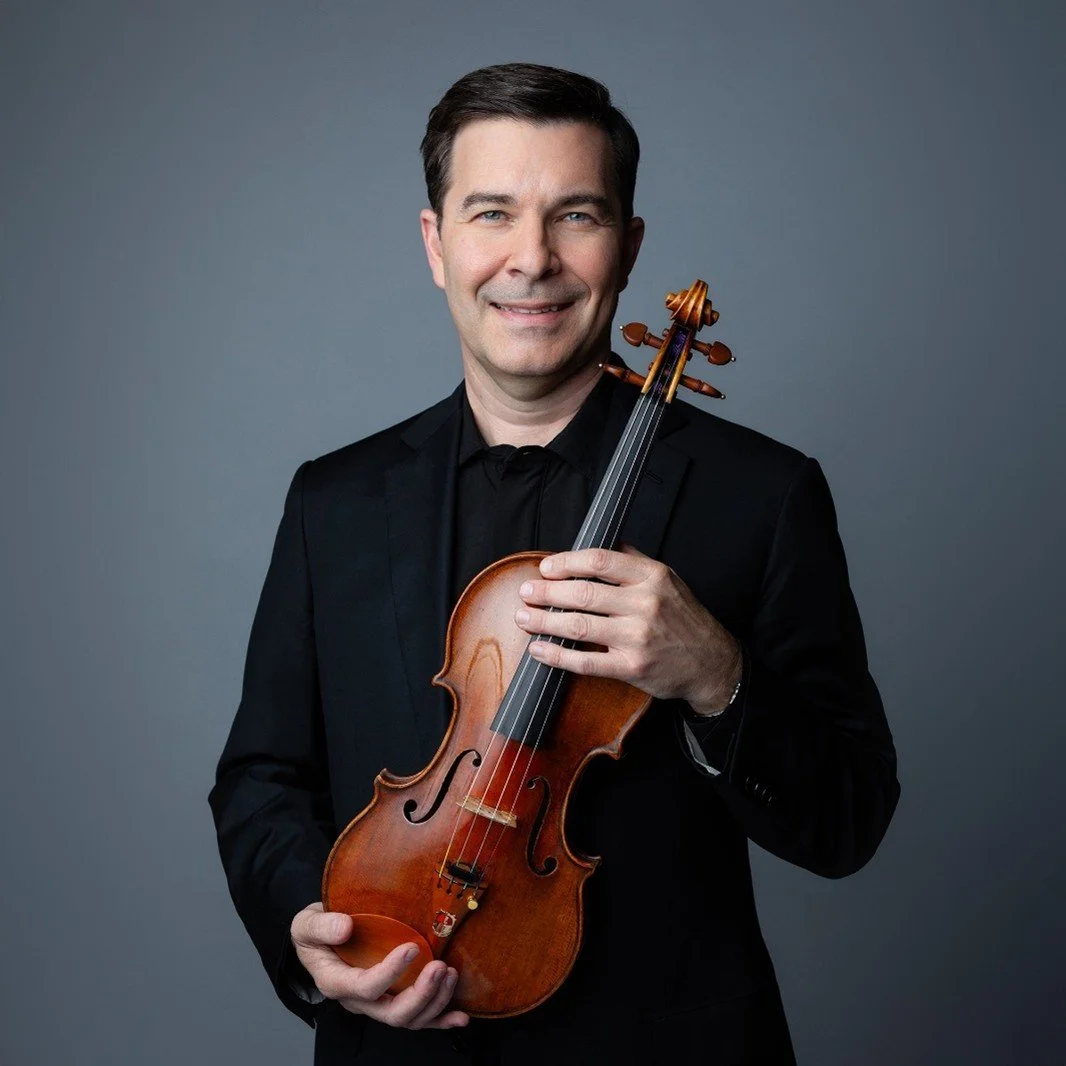
The Boston Symphony Orchestra recently hired Nathan Cole as its new concertmaster. The process took several years because of the complex way in which such selections are made. Gone are the days when a music director could simply choose personnel without the input of others. (Photo source: Boston Symphony.)
But such practices were long ago abandoned in major orchestras owing in part to musician activists working through their union. Today, the process of personnel selection in many orchestras requires that the orchestra musicians play an outsize role. Take the Boston Symphony Orchestra that recently hired a new concertmaster—Nathan Cole. The process took years.
Why? Because a committee of 15 orchestra players heard the auditions and voted on which candidates, if any, the music director could consider. Sometimes they could not agree on any candidates and auditions had to be held again. Even if the music director wanted to intervene to hire his preferred player, that individual could not be considered unless he or she had been advanced by the musician committee.
There is some lively debate about whether this is a good thing. Musician input certainly avoids the capriciousness of a single individual. But it also means that music directors cannot shape the style and sound of orchestral playing like they once did by having sole control over the selection process. Some people argue that the distinctiveness of great orchestras of yesteryear has given way to a more homogenized sound owing to the fact that the music director can no longer control the hiring.
There is a certain irony here. While the decision about who plays in an orchestra is in large part in the hands of its musicians, the selection of the music director, arguably the most important musician in the organization, is made by a board of directors aided by the chief executive—none of whom are likely to be active professional musicians and may be serving because of their wealth rather than their musical knowledge. A responsible board does often defer to its musicians’ opinions. However, in a recent, much publicized decision by the Boston Symphony board of directors, a very distinguished and beloved (by orchestra members) music director’s contract was not renewed. This came as a shock to musicians who were not consulted in the decision.
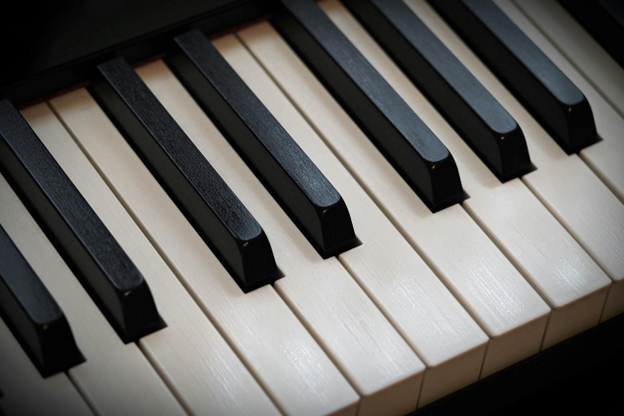
When one plays a note on the piano or other keyboard instruments, the pitch of that note never varies. But that represented a compromise in the original design of keyboard instruments that allowed them to play in any key. Singers and other instrumentalists have always adjusted the pitch of a single note depending on the musical context. (Photo source: Ralf Ruppert via Pixabay.)
MYTH #5 — An F-sharp is an F-sharp is always an F-sharp.
For all of you who are not musicians, I promise not to get very technical here. The assertion above is that when you hit a note on the piano like an F-sharp (or any other note), it should always sound as the same pitch. It can be louder or quieter, shorter or longer, but not higher or lower. And of course, on the piano it is always the same.
But when applied to the voice or other instruments, this assertion—that the pitch of a particular note never varies—is a myth. So why is it that way on the piano? The unvarying pitch of a particular note on the piano arose through a compromise that designers and fabricators of keyboard instruments decided upon centuries ago in order that these instruments would be able to play in any key. They decided that a particular note on the keyboard would always have the same pitch—it would never be higher or lower. That compromise was something that many musicians at the time felt was egregious. Singers and string players and any instrumentalists who could control the pitch of a single note adjusted pitch, varying it slightly depending on how the note fit into the music being played. We call this “expressive intonation.” Take that proverbial F sharp. On the piano it is always the same. But on other instruments, if one is playing, let us say, in the key of G, that F#—which is the note immediately below the root tone of G—is the so-called “leading tone,” and in many cases will be sung or played slightly higher than the note as played on the piano.
Here is Michael Reynolds, the long-time cellist of the Muir String Quartet explaining: “In his free moments, [my teacher, the late Mischa Schneider of the Budapest Quartet] and I spent hours discussing the value of expressive intonation. A loose definition would be that one has the license to bend pitch in a particular way to create a specific feeling or character. For example, a high F-sharp in the key of G can create a feeling of yearning or reaching, whereas a slightly lower F-sharp simply sounds dull and without intention.”[v]
While listeners may not consciously notice these slight variations in pitch, they do notice them subliminally and it is part of what makes a performance more expressive or dynamic. Musicians are more aware of this at a conscious level. As a professional flutist, I was constantly adjusting pitches of individual notes depending on how they fit into a phrase or a scale pattern or a chord structure. In time, I didn’t have to study when to make these adjustments—it was something that became automatic as my ear led me to the proper pitch.
So, though we may call all those F-sharps the same, they aren’t.
Though I know they are myths…
Okay, I have been as fair as I can be. I have shared much evidence about controversial myths. But I have to confess. As much as I believe in fact-based evidence, there are some classical music myths that I still refuse to reject. Can you guess if any of the ones described here are among them?
[i] A luthier is someone who makes and repairs string instruments.
[iii] Sight over sound in the judgment of music performance | PNAS. I am grateful to Malcolm Kottler for referring me to this study.
[iv] https://news.harvard.edu/gazette/story/2013/08/the-look-of-music/
[v] This quote comes from an article which offers a more technical explanation of expressive intonation. https://www.thestrad.com/playing-hub/what-in-tarnation-exploring-expressive-intonation-with-cellist-michael-reynolds/20991.article