Is it Okay for a Musician to Give an Intentionally Mediocre Performance?
By Thomas Wolf
OKAY, I AM ASSUMING you are not someone who, after reading the title of this blog, said, “of course it isn’t okay for a musician to give an intentionally mediocre performance! What a dumb question!” … and then moved on. But assuming you are still reading this, let me tell you a true and surprising story shedding additional insight on the question—a story about one of the greatest violinists of all time—Jascha Heifetz.
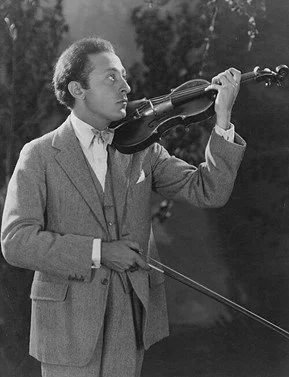
Jascha Heifetz, considered one of the greatest violinists of all time. When my grandmother and uncle attended one of his concerts in Florida, they were in for a surprise. (Photo source: Wikimedia Commons.)
Many years ago, my grandmother, Lea Luboshutz, and her pianist son, my uncle Boris Goldovsky, were scheduled to give a recital in Florida. My grandmother, being a nervous traveler, opted to go a few days early. As they were checking into the hotel, the desk clerk, seeing my grandmother’s violin case, said it was so interesting that there was another violinist staying at the hotel who was playing a concert that very night. When they learned it was the great Jascha Heifetz, a family friend and a musician they greatly admired, they asked where they could purchase tickets. The desk clerk didn’t seem to know, but he did know where the concert was to take place and he mentioned a large hall. Not seeing anything about the concert in the newspaper, they decided to eat an early dinner, and go to the hall to purchase tickets, hoping the concert was not sold out.
My grandmother always liked to arrive at a hall early, even when someone else was playing, so she was not surprised when they were the first audience members to enter the auditorium. But as time passed and very few people joined them, they began to wonder whether there was some mistake. The time of the concert arrived and there were fewer than a hundred people in a hall with a capacity of nearly 2,000 seats. Ten minutes later, Heifetz arrived on stage with his pianist, took one look at the paltry audience, and proceeded to play very poorly. My grandmother and uncle could not believe what they were hearing. This was one of the violinists they most admired, a musician whose performances never departed from near perfection. This sounded like the playing of a mediocre student.
At intermission, my relatives had to decide what to do. On the one hand, if they went backstage, it was clearly going to be embarrassing. On the other, if Heifetz had spied them in the sparsely filled hall during the first half or even if he hadn’t and it got out that they had been at the performance and had not gone backstage to say “hello,” it would lead to even greater embarrassment. They decided to go greet the artist.
Heifetz was in a surly mood when they arrived. “What are YOU doing here?” he growled. But my grandmother, who was always most polite, spoke about how wonderful it was to see him as always, news about mutual friends, their own upcoming concert in a couple of days, and other small talk.
When the second half started, everything changed. According to my grandmother, “He played like a God. Just what one would expect from Jascha Heifetz.”
Later they learned the back story. A wealthy gentleman who had visions of becoming a concert presenter, had engaged Heifetz to play the concert but had no knowledge of how to promote it. When the violinist, who regularly played to sold out halls, saw the empty auditorium, he was infuriated and played badly… obviously intentionally. Once he knew fellow musicians and friends were in the house, he resorted to his usual superb playing.
Factors (Excuses?) for a Less than Stellar Performance
Many would say a musician should never resort to such a practice and I would agree. However, what if we were to modify the question somewhat? Let’s acknowledge the tremendous effort it takes for musicians to play or sing at top form and ask if there are situations when a performer may not give his or her absolute best? Non-musicians may be unable to appreciate the mental concentration, nervous energy, and physical dexterity involved in maintaining a musician’s peak performance. Likewise, it is difficult to appreciate the toll of being on the road for days, weeks, and sometimes months on end, playing program after program and often dealing with social and media commitments in addition. Having spoken to many musicians about this and having been a touring musician myself (I did fourteen tours with my uncle’s opera company as flutist and company manager), I enumerate some occasions when musicians may not endeavor to give their absolute best (and this list is hardly comprehensive).

Tired musicians often do not give maximum effort to a performance. Just “getting through” is about all they can manage. (Photo source: Creative Commons.)
Fatigue
The most obvious place to start is fatigue. It is probably not good to do almost anything demanding when one is tired. The body and mind simply rebel. For concert musicians, fatigue is an enemy of great presentations. The temptation is to “go through the motions” (as one musician described it), performing by habit and rote. Often, that is sufficient to get by, especially when players are part of an orchestra or large ensemble. They can coast. But even a soloist knows how to bypass the extra effort involved in a great performance and often get away with it. One’s colleagues may notice, sophisticated listeners may notice, but it may be difficult for most audience members to tell.
Boredom

Boredom is another enemy of great playing. The challenge of unchanging touring and performing routines often do not provide enough new stimuli. (Photo source: Creative Commons).
Along with fatigue, boredom is an enemy of exceptional playing. In my own case, traveling with a touring opera company and playing the same repertoire as a member of the orchestra night after night for several weeks, it was easy to become bored. The routine of bus trip, hotel check in, mediocre meal, travel to the venue, playing the performance, returning to the hotel, could, over time, become like a sensory deprivation experiment. Not enough new stimuli to perk up one’s interest in just about anything. My colleagues in the pit and I were often on auto-pilot during performances, especially in the middle of a long tour when one knew the repertoire cold but it wasn’t close enough to the end of the run to have something to look forward to. Once again, auto-pilot was often “good enough,” but not great.
Anything to fight the monotony was desirable. Days off were important as were multiple days in the same location when one had time to break the routine. It could be fun to explore a new or even a familiar city; look up friends and colleagues who might live there; find a great restaurant (especially one that was open late); playing chamber music informally with colleagues; shopping; visiting a museum; and a host of other seemingly minor activities. Some musicians resorted to drugs. Many engaged in sexual activity.
One thing that relieved boredom and increased alertness was performing in an important city or venue. The stakes were higher and there was pride involved. Orchestra members have told me how much better they play when their ensemble performs in a venue like Carnegie Hall, for example, or in some famous European concert hall. But even more modest venues can jolt a musician out of lethargy, especially when one knows that important musicians or critics are in the audience.
Distractions
It is surprising how small distractions can undermine superior playing. Auditory distractions are especially annoying as one is concentrating on the sounds one is producing: audience members talking during the performance, laughter that is not an expected part of a presentation, noisy children, the ring of a cell phone, crackling candy wrappers, whistling hearing aids, a slamming door—all these things can interfere with the intense listening that a musician relies on to perform superbly.

Distractions, especially auditory ones, can drive musicians crazy and interfere with superb playing. (Photo source: Wikimedia.)
Auditory distractions can happen on stage or in the pit as well like a missed or incorrect entrance by a fellow musician, out-of-tune playing, unexpectedly harsh dynamics. There are plenty of non-auditory distractions: the flash of a camera, foot tapping by an audience member that does not quite align with the beat, late comers being seated once the music has begun, or people getting up to leave before the playing has ended. Anything that interferes with intense concentration or makes one lose mental acuity is problematic.
Poor venue/bad acoustics
The essence of music is sound and for performers, the sound they produce is part of their personalities. There are many things that contribute to a wonderful sound, including the performers’ physical make-up, their skill, and their instruments (including a singer’s voice which is also an instrument).

Nothing like a poor venue, specially one with bad acoustics, to discourage musicians and keep them from making the extra effort of trying their best. (Photo source: Creative Commons.)
But another factor contributing to a good sound is the acoustics in the venues. A dead hall is the enemy of a beautiful rounded sound—the sound is absorbed and dies; a hall that is too live leads to a mish-mash of sound when the resonance goes on too long. Some halls have dead spots on stage making it difficult to hear colleagues. A musician who is playing in a pit orchestra needs to feel connection to the sound on stage—seeing the conductor is often not enough. At a certain point, if the acoustics are really poor, one gives up and does one’s best under the circumstances. It’s just not worth more effort.
There are other aspects of poor venues. It is discouraging to look out and see a poorly maintained hall—paint peeling, broken seats, poor lighting (the list is long).
Lousy hotel/bad food
Many people imagine the life of a touring musician is glamorous. We read about superstars who occupy suites in the best hotels, with numerous assistants nearby tending to their every desire. But most professional musicians are not superstars and they often play in places where lavish hotels and restaurants are not available. For those that pay their own travel expenses, booking affordable but high-quality hotels can be challenging. Artist managers can help and often do their best. But even for high profile musicians, lousy hotels, unkempt rooms where the internet is not working, the shower water tepid, the bathtub drain not holding water, or other irritants, can lead to a surly mood that is not conducive to spirited playing.
On one tour, the violist Richard Young of the Vermeer String Quartet, told me that after a series of bad European hotels in which he routinely was assigned unsatisfactory rooms and had to request room changes, he resorted to a new tactic. As he checked into the next hotel and received his key, he handed it back to the desk clerk and said, “Now give me the key to the room that you are going to give me when I complain about this one.”
A bad hotel is one thing. The unavailability of good food is another. Many musicians have very specific eating routines that include the freshest vegetables and fruits, low starch offerings cooked with a light touch and no heavy gravy, and importantly, a full range of food offerings after the performance since musicians tend to eat lightly before they perform. It is frustrating when the only thing available late in the evening is food from a vending machine.
Small and/or unsympathetic audience
When a musician walks out on stage and sees a tiny audience in a large hall, it has the potential to have a negative impact on the performance. Disappointment and even anger can lead to questions about self-worth. Of course, all kinds of things can have an impact on audience size and it is often the presenter who is at fault. But the negative feelings such things engender are not only depressing to performers, they can be felt by audience members (Why am I here? This must not be as good as I thought it would be…) causing a vicious circle of negativity.
As depressing as it is to see a small audience, a less-than-enthusiastic audience is also a downer. A musician gives his or her all to a performance and if the reaction is paltry—we musicians refer to these as “dead” audiences—it hardly seems worth making an effort if the reaction is so underwhelming. My favorite audiences have been Russian ones. The enthusiasm, the bravos, the standing (and long ovations), the demand for encores even when the performances are unremarkable—how can musicians help giving back at a high level?

These ladies are trying hard. But the singing jester is like those less-than-ideal colleagues who make great performances challenging. (Photo source: Creative Commons.)
Less-than-ideal collaborators
Most experienced musicians have to endure playing with less-than-ideal colleagues from time to time. Orchestra musicians talk of inexperienced or incompetent conductors who hide their lack of skill and experience by hectoring orchestra personnel. Or they talk about a colleague whose intonation is slightly off making it very difficult to play in tune as an ensemble. Chamber musicians speak of being thrown into a group with players with whom it is difficult to work. Often this has less to do with poor technical skills (although this can occur when, for example, a donor puts pressure on an artistic director to hire a certain player who is not up to the mark). Much more common is an individual who is musically inflexible, insistent on getting his or her way, someone who makes the entire experience of rehearsing and performing uncomfortable. Under these circumstances, one can “go along” knowing that the result will be less than ideal.
Unstimulating programming
I once asked a friend of mine, a clarinetist, what was the most unsatisfying repertoire he ever played that may have impacted his level of effort. His answer surprised me: Tchaikovsky’s “Nutcracker” Ballet.
“Wait a minute,” I interjected. “That is a great piece of music.”
“Try playing second clarinet 10 times a week for five weeks. After a while it’s not so great.”
If a composition as great as “Nutcracker” can be unstimulating, then what about all the “shlock” that musicians—especially orchestra musician playing lots of Pops concerts—are forced to play?
Remember, in a high-quality professional orchestra, the musicians are generally conservatory-trained and have worked on the masterpieces for their instruments or voices. To be reduced to playing, for example, cheap arrangements of Christmas Carols during the holiday season over and over again or the latest Pop or Rock tunes, can be very unsatisfying. Nor is it challenging. As a result, many musicians simply sight-read their parts at a single rehearsal that precedes the concert or at the concert itself.
In my own case, sitting in the pit during opera performances, there were some composers whose work I loved no matter how many times I played their works and others where the orchestra writing was unstimulating. While the singer on stage would be executing magnificent runs and high notes, I would be sitting in my seat playing an “oom-pah-pah” accompaniment. Even leaving out a note or two didn’t impact the performance, and I was often tempted.
And Yet…
And yet, every once in a while, even when it seems that many factors described above are present and would lead to a less-than-stellar performance, something magical can happen anyway. I can still remember one of these events from more than fifty years ago during the spring of 1971. Our company, the Goldovsky Opera Theater, had been on the road for several weeks. We were touring through the southern United States playing a series of what are called “one-nighters” (single performances in small venues with considerable travel between cities each day). We had done eleven performances in a row without a day off and we were all tired and cranky.
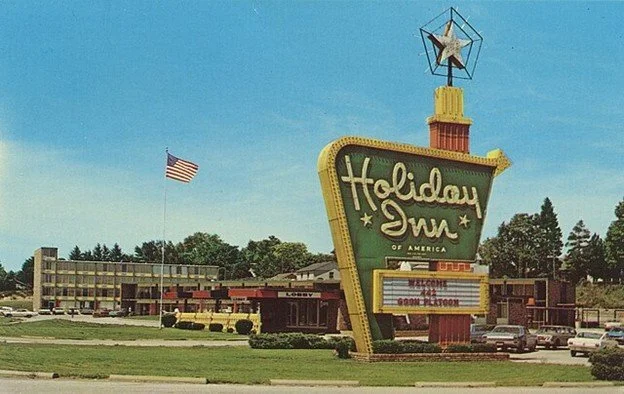
In smaller communities in the 1970s, our touring opera company, Goldovsky Opera, often stayed at Holiday Inns (not company members’ favorite chain) when it was the only option to accommodate so many people. Typically, the restaurants and bars closed before the company returned from performances, increasing the unhappiness during long tours. (Photo source: Steve Shook, Creative Commons.)
After so many weeks on the road, performing the same opera night after night, we were getting bored—with the opera and with one another. Tempers were short. As we arrived in a small city in Arkansas, we realized that this was another of those so-called “en route” performances—an unimportant event booked between two larger cities to maximize the weekly fees collected by our agent. There we were at yet another Holiday Inn (not the company’s favorite hotel chain by a long shot but the only one available to accommodate so many people) and we learned, much to our irritation (as we had at several previous stops that week), that the bar and restaurant closed at 10:00 pm, well before we would arrive back from the performance, hungry and thirsty.
I do not remember much about the hall. I searched the internet recently but I couldn’t find any reference to it. It had to have been a large enough auditorium to accommodate an opera company of some fifty people and it must have had decent acoustics. Perhaps it no longer exists. As we disgruntled company members got on the bus to go to the hall, I imagined the drudgery of yet another less-than-stellar performance. But whatever happened that night, somehow the performance was magical. Ronald Holgate, who would go on to receive a Tony Award for his performance in the musical 1776, was still singing operatic roles at the time and he was our Don Giovanni. His energy from the first scene was infectious. Other members of the cast stepped up. Those of us in the orchestra were more alert than usual, realizing something special was happening. The performance sizzled, the audience responded throughout the show… it was one of the best on the whole tour. Go figure.
And that is precisely the way our conductor and company director reacted. As we orchestra members waited on the bus to return to the hotel, the last to arrive was Boris Goldovsky himself. He had just a few words for us. “Thank you all… It was simply amazing… Go figure!”