Arts Advocates: Should You Be Careful What You Claim?
By Thomas Wolf
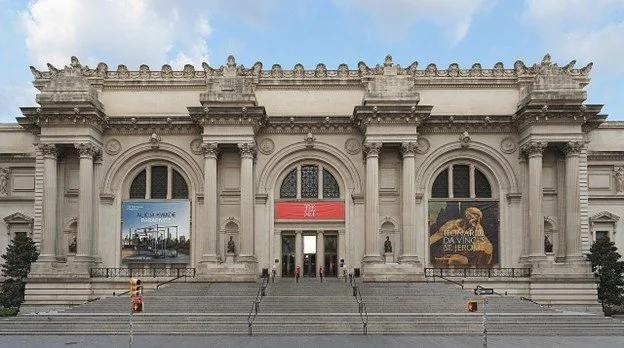
New York’s Metropolitan Museum of Art. Did its audience really exceed that of New York’s baseball teams? (Photo source: Hugo Schneider, CC BY-SA 2.0, via Wikimedia Commons.)
IN THE MID-1970s, the Advertising Council of America produced a public service television spot featuring Billy Martin, the manager of the New York Yankees baseball team. In it, Martin told viewers that the arts not only attracted more people than baseball, but they drew more people than all of sports combined. Billy was shown with his foot up on a bench in a busy gallery of the Metropolitan Museum of Art in New York (the Met) admitting, in a rare humble moment that the Yankees had come in second, not to their baseball team arch rival—the Mets—but to the Met.
It was a wonderfully humorous piece—both accurate… and misleading. Its veracity depended on the statistics that were being used to compare arts and sports. One could be forgiven for drawing the wrong conclusion, as many people did, that the arts were more popular than sports if it were true that more people attended arts events than attended sport events.
The problem with the comparison was that the arts are almost exclusively enjoyed by live audiences while the live audience for sports events is dwarfed by fans that take in games through media. To make this clear, take a look at a single high-profile sports event—the football Superbowl. Live attendance at the Superbowl has generally hovered around 70,000 people. In 2025, peak numbers via media for Superbowl LX reached over 137 million.
Another way to think about why the television spot was potentially misleading is to imagine two platters of fruit. One contains three apples (call that the arts platter). The other contains only a single apple but 20 oranges (call that the sports platter). The statement that the first platter has three times as much as the second is true if one is only comparing apples. But the further assumption that the first platter contains more fruit than the second platter is not true.
Of course, the problem between live and virtual attendance was only the tip of the iceberg in terms of misinterpretations of Billy Martin’s statement. By choosing the Metropolitan Museum of Art, viewers might infer that Martin was suggesting that it was the nonprofit arts that outdrew baseball. In this case, “the arts” would include such non-commercial organizations as museums, orchestras and smaller music ensembles, theatre companies, dance troupes, and various entities like youth-serving and community arts organizations.

Disney’s annual revenue alone is larger than every nonprofit cultural institution combined. (Photo source: Coolcaesar, CC BY-SA 4.0, via Wikimedia Commons.
Yet according to a recent piece by Douglas McLellean, the nonprofit arts sector totals less than a billion admissions annually (965 million) while the for-profit arts sector that most likely was also part of the calculation in the Billy Martin spot drew an additional 1.367 billion. And when it comes to revenue, according to McLellan, “the nonprofit arts sector is small— about $73 billion in annual organizational spending compared to $1.17 trillion in total US arts and cultural production. Disney’s annual revenue alone is larger than every US nonprofit cultural institution in the country combined.”
Arts advocates are often guilty of making claims that, while they may literally be true, suggest take-aways that are not. Consider, for example, the so-called “Mozart effect.” In a 1993 study by Frances Rauscher, Gordon Shaw, and Catherine Ky published in Nature, 36 college students were tested on spatial reasoning tasks after listening to a 10-minute segment of Mozart’s Sonata for Two Pianos in D Major (K. 448). The effects of the Mozart listening session were compared to a tape of relaxation instructions on the one hand and 10 minutes of silence on another. Following each of these three “conditions,” students completed a task measuring spatial-temporal reasoning—the ability to mentally manipulate shapes and patterns. The result was a short-term improvement in things as mundane as paper-folding. There was, however no long-term measurable effect.

Does listening to Mozart really make one smarter? Probably not. (Photo source: Barbara Krafft, Public domain, via Wikimedia Commons.)
Here was a tiny, unreplicated study of an unrepresentative sample of only 36 subjects with very modest claims. Yet, the hoopla that surrounded its findings was immense. The media—and sadly, many arts advocates who should have known better—hyped the study, asserting that listening to a bit of Mozart increased general intelligence. Numerous commercial products were successfully marketed, many directed to parents of newborns. The Governor of Georgia supported a budget line to provide every newborn in the state with a classical music CD. Even today, almost a quarter of a century after the study was completed and after bogus claims for exaggerated effects had been refuted time and time again, one can still find videos on YouTube hyping the “Mozart Effect.” One of these with over 500,000 views claims “10 Minutes of Mozart Can Give You a Perfect Brain Day.”
Finally, there is research about the impact of arts audience’ spending on local economies. Not only do audiences for arts events pay admission fees, but they often go out for a meal, hire a babysitter, pay for gas and parking, and so on. In many studies, each of these additional expenditures is considered “arts-related spending.” These ancillary payments are then taken into account when measuring economic impact of the arts and assessing whether the arts deserve greater public support.
But couldn’t one just as well assert that it is the restaurant sector that should be credited, not only with the meal payment but for the fact that the patrons decided that as long as they were going out for a meal, they might as well take in a show as well. In that case, the economic impact of restaurants would be enhanced by the ticket purchases to arts events.
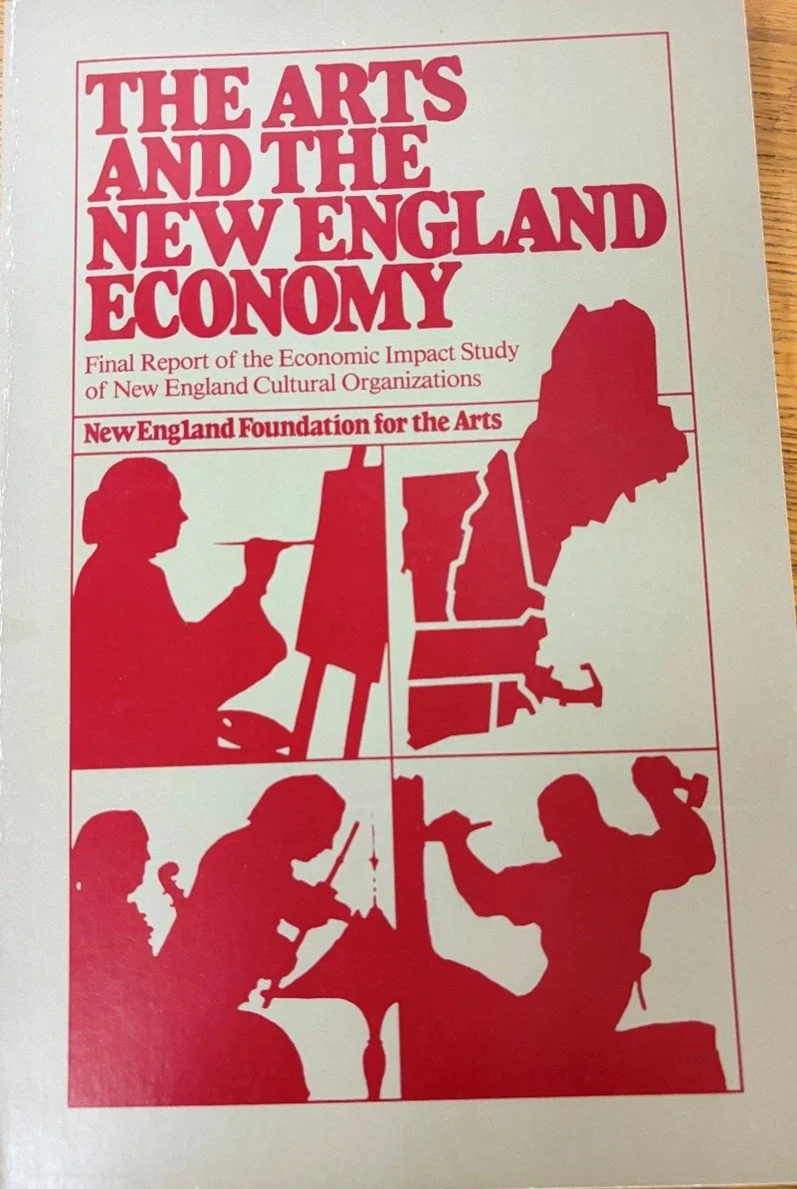
First edition of The Arts and the New England Economy (published in 1980 by New England Foundation for the Arts) for which I was the project director. This was one of the first economic impact studies of the arts to utilize the RIMS multiplier.
Furthering claims of the economic impact of the arts, many studies (including two that I oversaw) utilize something called a RIMS multiplier, an economic tool developed by the US Bureau of Economic Analysis. The rationale for its use comes from the idea that when money is injected into a local economy, it has a multiplier effect that goes well beyond the original investment. Monies that are paid in salaries, for example, go to purchase food at a local supermarket which in turn pays a distributor who then pays food producers. This has a ripple effect such that a single dollar is worth far more in its impact once the ripple effect is complete. Using the multiplier enhances the argument that government should invest in the arts because it is a good way to juice up local economies.
There are a couple of things wrong with this picture if the RIMS multiplier is misused. First, not all the money that audiences spend on the arts, either directly or indirectly, stays local. Consider, for example, an orchestra that hires a big-name guest artist who will carry his fee to a different geographic area. That portion of the audience admission revenue allocated to the fee should not get credit for local enrichment via a multiplier. Second the application of a multiplier is not unique to the arts sector. A public policy dollar invested in another sector—for example a local sports stadium—will have at least as much impact through a multiplier as a dollar invested in the arts.
So why aren’t people more careful when it comes to making claims about the benefits of the arts? Quite frankly, because shoddy research and even shoddier interpretations can have positive results in convincing policy makers of the importance of the arts—whether for economic development, educational outcomes, good health, and a variety of other public goods. Elected officials faced with studies that assert the beneficial impact of the arts on the economy, on education, on health or on anything else (especially when dressed up in elegant scholarly-looking presentations), are not going to subject such studies and their conclusions to time-consuming analysis.
The sad truth is that truly rigorous research, often with more modest but well-tested results and supportable conclusions, often cannot compete.